
What Mixpanel actually costs
Mixpanel's mixpanel pricing is not a flat monthly fee, and that is the first thing to understand about it. You do not pick a plan and pay the same amount every month. You pay based on how much you track, measured in events, so the real cost depends entirely on how busy your product is.
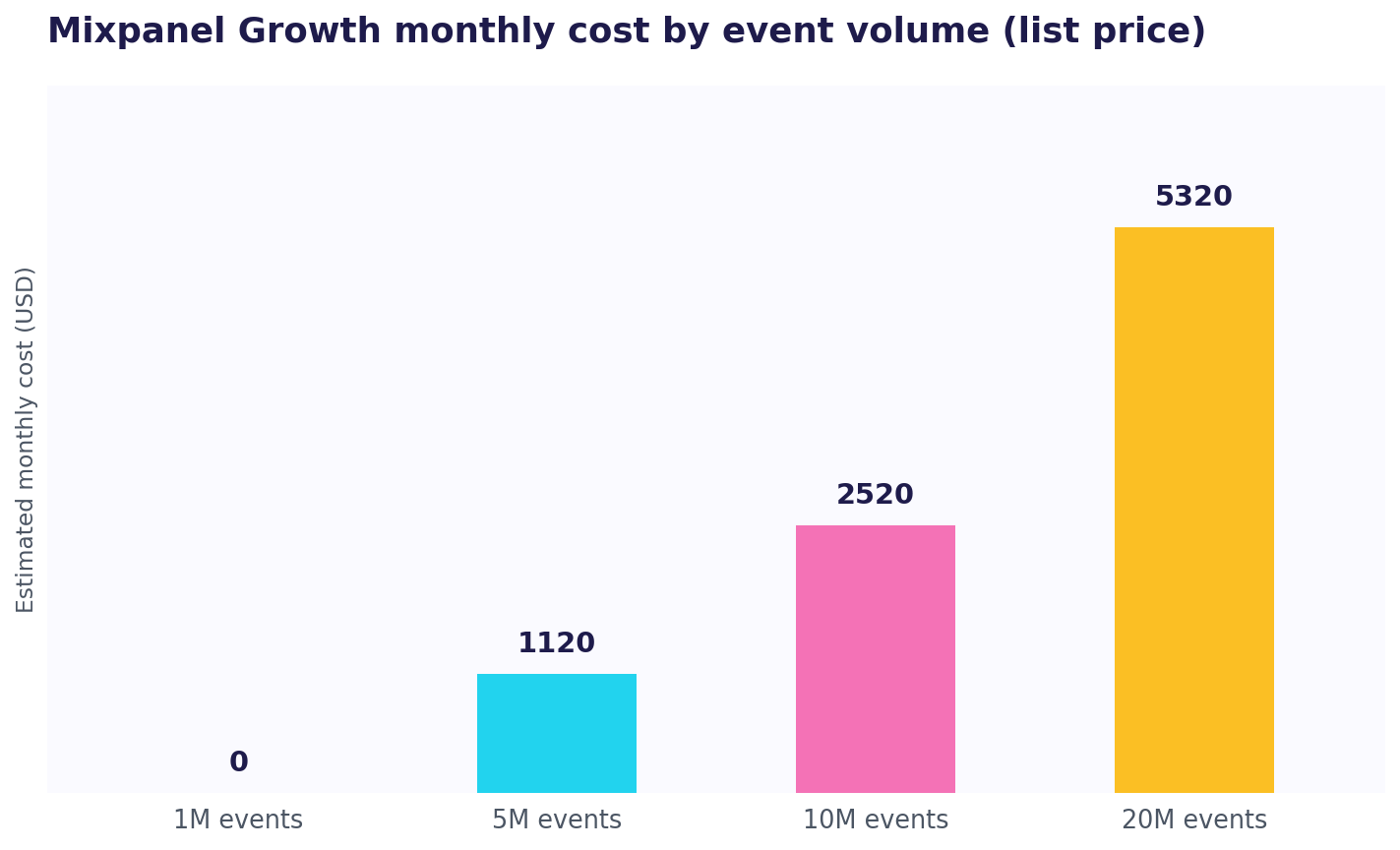
Here is the current structure, from Mixpanel's own pricing page. The Free plan is capped at one million events a month, with up to five saved reports and ten thousand session replays, and needs no credit card. The Growth plan "starts at $0": it includes that same one million events free, then charges $0.28 per additional thousand events beyond it, with volume discounts as you scale. Enterprise, with unlimited events and heavier governance, is custom-quoted through their sales team.
Is the free plan enough for an early-stage startup?
For most founders who are genuinely early, yes, and by a wide margin. One million events a month sounds small until you count what an event actually is. If a single visitor's session fires ten tracked events, that free tier covers a hundred thousand sessions a month before you pay anything. A product still hunting for its first thirty customers is nowhere near that ceiling.
So the honest read on mixpanel cost at the beginning is: it is free, and the free tier is generous. Anyone telling an early-stage founder that Mixpanel is expensive is describing a problem they do not have yet. The cost is real, but it arrives later.
Why Mixpanel gets expensive
The bill grows for a reason that is easy to miss when you set it up: you control the number of events, and the natural instinct is to track more of them. Every button, every page, every little interaction can be an event, and each one counts toward your total. A product that instruments heavily, or simply gets popular, can go from a few hundred thousand events a month to tens of millions surprisingly fast.
At $0.28 per thousand events past the first million, ten million events a month is roughly nine million billable events, which lands in the low thousands of dollars monthly. That is not a criticism of Mixpanel, it is the trade of usage-based pricing: it is cheap when you are small and scales up exactly as your usage does. The thing to watch is that the growth is driven by your own tracking decisions as much as by your traffic, so a tidy event plan keeps the bill honest.
Where it fits, and where it does not
Mixpanel is deep product analytics: funnels, retention, cohort analysis, the machinery for understanding how people use a feature-rich app over time. If that is the question you have, it is a serious, capable tool, and there are other tools like mixpanel, such as Amplitude and PostHog, built for the same job.
But it is worth being clear about what that job is, because it is not the same as early user acquisition. Product analytics is built to measure how your existing users behave in aggregate. It is not built to tell you that the specific founder you emailed on Tuesday clicked your link and read your pricing page. For a founder whose main question is still "is this landing with the people I am reaching," a heavyweight event-analytics platform is more machine than the moment calls for. ScoutVibe is built for that earlier question instead: which person engaged, and what did they do, without an event-volume meter running. If you do want a full product-analytics tool but not Mixpanel's bill, we compared the best Mixpanel alternatives separately.
Mixpanel is deep product analytics, priced by event volume and built to measure existing users in aggregate. It will not tell you the specific prospect you emailed engaged. ScoutVibe answers that earlier question, which person, without an event meter running. The free tier covers your next launch.
Try ScoutVibeFAQ
How much does Mixpanel actually cost?
It depends on your event volume, not a flat fee. The Free plan covers up to one million events a month at no cost. The Growth plan starts at $0, includes that first million events, then charges $0.28 per additional thousand events, with volume discounts. Enterprise is custom-quoted. So your bill is a direct function of how much your product tracks.
Is Mixpanel's free plan enough for an early-stage startup?
Usually yes, comfortably. One million events a month is a lot when you are early: if a session fires ten events, that is around a hundred thousand sessions before you pay anything, far more than a startup chasing its first customers will see. The free tier is generous enough that early-stage worries about Mixpanel's cost are mostly premature.
Why does Mixpanel get expensive?
Because you pay per event, and the number of events is largely up to you. Every interaction you choose to track adds to the total, so a heavily instrumented or fast-growing product can climb from hundreds of thousands to tens of millions of events a month. At $0.28 per thousand past the first million, that scales into the thousands of dollars. It is the nature of usage-based pricing, and a disciplined event plan is what keeps it in check.