
Your analytics dashboard can tell you that 1,000 people visited last month and 30 of them signed up. What it almost never tells you is the part that actually helps: what the other 970 did before they left, and what those 30 did differently on their way in. That path, from the first time someone hears about you to the moment they buy and beyond, is the customer journey. Tracking it is how a small team turns a wall of totals into a story it can act on.
This guide is written for founders and small teams, not enterprise analytics departments. No data warehouse, no dedicated analyst, no six-figure tooling budget. Just a practical way to see the journey your real customers take and to fix the specific place where most of them fall off.
What customer journey tracking actually means
Customer journey tracking is following the sequence of steps a single person takes across your marketing and product, in order, rather than counting everyone in aggregate. Standard web analytics answers "how many." Journey tracking answers "in what order, and where did this person stop."
The difference sounds small and is not. A pageviews report tells you your pricing page got 400 views. Journey tracking tells you that a specific prospect read a blog post, came back two days later from an email, viewed pricing, started signup, and quit at the payment step. The first view is a number. The second is a diagnosis.
For a small team chasing its first 30 or 100 paying users, the diagnosis is the whole game. You do not have enough traffic for aggregate percentages to be stable, but you can absolutely read individual journeys one at a time and spot the pattern.
It also helps to be precise about the word "journey," because it is easy to confuse with a conversion funnel. A funnel is a fixed set of steps you defined in advance and then measure drop-off between. A journey is the actual route a person took, which often ignores your tidy funnel entirely: they arrive from a channel you forgot to tag, wander sideways, leave, and come back a week later. Funnel analytics tells you how many cleared each gate. Journey tracking tells you the real, messy path, which is where the surprises live. You want both, but only one of them shows you behavior you did not already expect. If you are still setting up the basics, how to track website visitors covers the groundwork this guide builds on.
The stages of a customer journey
The most durable model of the journey comes from McKinsey's research on the consumer decision journey, which studied the purchase decisions of roughly 20,000 consumers across five industries and three continents. It replaced the old linear funnel with four connected phases that loop rather than end:
| Stage | What the person is doing | What you want to see |
|---|---|---|
| Initial consideration | Becoming aware, forming a shortlist | Which channel introduced them |
| Active evaluation | Researching, comparing options | Which pages and content they return to |
| Closure | Choosing and buying | Where signup or checkout succeeds or breaks |
| Post-purchase | Using, judging, deciding whether to stay | Whether they activate and come back |
McKinsey's central finding is that the early stage matters more than most teams treat it: brands that make a buyer's initial consideration set are more than twice as likely to be purchased as brands that only get added later. In plain terms, showing up early and being remembered beats showing up loudest at the end. For a small team that means your first touch, the blog post or the cold email or the community mention, is not throwaway top-of-funnel. It is where the journey is often won or lost.
The other half of the model matters just as much: the journey does not stop at purchase. Post-purchase experience feeds back into whether someone stays and whether they tell anyone. A journey you only track up to checkout is a journey you are reading half of.
Why the journey is invisible in normal analytics
Most analytics is anonymous and aggregate by design, which is exactly why the journey disappears. The tools count events and group them. They do not, by default, hand you one named person and the full path they took. We covered why in anonymous visitor tracking, and it is the single biggest reason small teams feel like they are flying blind despite having analytics installed.
Here is where it bites. The average documented online shopping cart abandonment rate is 70.22 percent, calculated by the Baymard Institute across 50 separate studies. Seven in ten started-but-unfinished purchases is not a rounding error, it is the norm. Your dashboard will show you the drop as a number. It will not show you why any particular person dropped.
Baymard also asked people why they abandoned checkout, and the answers are the kind of thing journey tracking exposes and a totals report hides:
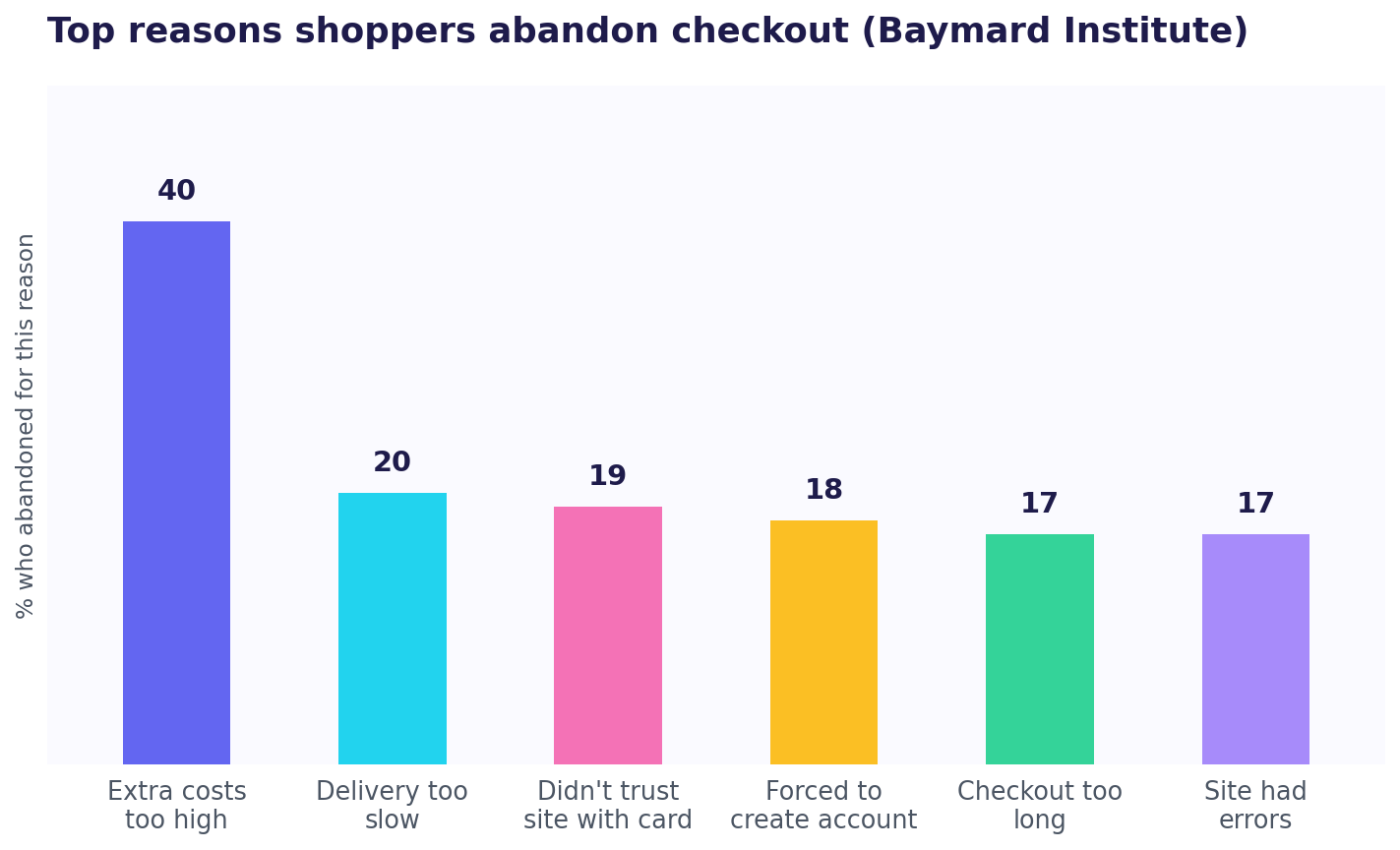
Notice that the top reasons are not "your product is bad." They are friction: unexpected costs, slow delivery, a forced account, a checkout that felt long or untrustworthy. Every one of those is a specific moment in a specific person's journey. You cannot fix a moment you cannot see, and an aggregate conversion rate shows you the outcome while hiding the moment.
What a small team should actually track
You do not need to track everything. Five things carry almost all the value:
- Entry point. Which channel or campaign introduced this person. This is what UTM parameters are for: tag every link you share so the source is not guesswork.
- On-site path. The pages this person viewed, in order, across visits. The order is the signal. Someone who reads three feature pages then pricing is a different story from someone who hit pricing and bounced. See tracking a visitor's path through your site.
- Key actions. The two or three moments that mean progress: signed up, activated, invited a teammate, hit the core value moment. Everything else is noise until these are covered. Most of these are clicks on a specific button or link, so tracking link and button clicks is usually how you capture them.
- The drop-off point. The last thing someone did before they left without converting. This is the highest-value data point you can collect, because it points directly at what to fix next.
- Post-purchase behavior. Did the person who paid actually come back and use the thing. A customer who never returns is a churn risk you can see coming.
How to track the journey without enterprise tooling
The practical stack for a small team is simpler than the enterprise version, and most of it you can stand up in an afternoon.
Tag your channels with UTMs. Every link you post, email, or DM gets UTM parameters so the entry point is recorded automatically. This is the cheapest, highest-leverage step and it needs no software beyond a spreadsheet and discipline.
Give people their own links. Aggregate analytics loses the person. A unique tracking link per person, the kind you hand to a specific prospect, investor, or community, lets you tie the on-site path back to a real human instead of an anonymous session. For early acquisition this is the difference between "someone from the newsletter visited" and "the prospect I emailed Tuesday read pricing twice and stalled."
Record the on-site path, not just the pageview. You want the sequence per person, not a bar chart of page popularity. That per-person path is what turns a bounce into a reason.
Watch two or three funnels, not twenty dashboards. Pick your one core conversion, first visit to signup, or signup to activation, and watch where people leave it. A single well-chosen funnel beats a dashboard nobody reads.
This is the specific gap ScoutVibe was built for. Rather than reporting aggregate traffic, it gives a prospect or community its own link, then shows the actual path that individual took through your site, which pages and in what order. You can even record an ideal path once, the route you wish everyone took, and watch how each real journey diverges from it. For a founder trying to convert early, hand-tracked attention, that per-person, divergence-from-ideal view is usually the one that decides the next move. If you want the broader landscape of options first, we compared the general-purpose tools in the best web visitor tracking tools.
Tracking individual journeys means handling personal data, so tell visitors what you collect and get consent where it is required. Per-person links work best for people you already have a relationship with, prospects you are talking to, subscribers, or community members who opted in, rather than anonymous cold traffic.
Common mistakes small teams make
Tracking channels but not people. Knowing 40 percent of signups came from Twitter is useful. Knowing which specific interested person went cold, and where, is what you can act on this week.
Only tracking up to the sale. The journey loops. If you stop at checkout you miss activation and retention, which is where a small team's real revenue lives.
Confusing a lot of data with the right data. Five tracked steps you review weekly beat fifty metrics you glance at once a quarter. Depth over breadth.
Installing analytics and calling it journey tracking. A pageviews tool counts. It does not, on its own, reconstruct one person's path. Be clear about which question your tool actually answers before you trust it to answer both.
Waiting for enough data. Big-company instincts say wait for statistical significance. At small scale that day never comes, and waiting for it means learning nothing. Read the journeys you have. Five real paths reviewed this week beat a significant sample you will have next year, because the qualitative "oh, that is where they get confused" arrives long before the numbers are stable.
A simple starting workflow
If you are beginning from nothing, do this in order:
- Put UTM parameters on every link you share, starting today, so entry points are captured going forward.
- Define your two or three key actions and make sure each one is recorded.
- Pick one core funnel and identify the single step where most people leave.
- For your highest-value prospects, use per-person links so you can read their journeys individually.
- Every week, read five real journeys end to end. Patterns show up faster than you expect.
That is a journey-tracking practice a team of one can actually maintain, and it will teach you more about why people do and do not buy than any aggregate dashboard. For the full, end-to-end treatment, see our complete guide to user journey tracking.
FAQ
What is the difference between customer journey tracking and web analytics?
Web analytics counts visitors and events in aggregate: how many people, from where, on what pages. Customer journey tracking follows one person's steps in order across the whole journey, so it answers "what path did this individual take and where did they stop," not just "how many showed up."
What are the stages of a customer journey?
The most cited model, from McKinsey, has four looping phases: initial consideration, active evaluation, closure or purchase, and post-purchase. It is a loop rather than a funnel because the post-purchase experience feeds back into whether someone stays and recommends you.
Do small teams really need customer journey tracking?
Yes, and arguably more than big companies. Small teams have too little traffic for aggregate percentages to be reliable, but they can read individual journeys one at a time. Seeing exactly where a real prospect stalled is more actionable at small scale than any conversion-rate average.
How do I track a customer journey for free?
Start with UTM parameters on every link, which cost nothing, then track your two or three key actions and one core funnel. Several tools have free tiers for the on-site piece. The method matters more than the spend: capture entry point, path, and drop-off, and review real journeys weekly.
Why do so many customers drop off before buying?
The Baymard Institute puts the average documented cart abandonment rate at 70.22 percent, and its top reasons are friction rather than disinterest: unexpected extra costs, slow delivery, forced account creation, and long or untrustworthy checkouts. Journey tracking is how you find which of these is costing you specifically.
Standard analytics counts your visitors. It does not show you the path any one prospect took or where they stalled. ScoutVibe gives a person their own link and shows their real journey through your site, so you can see exactly where to help. The free tier covers your next launch.
Try ScoutVibe